Friday, April 25, 2014

Brain Scraper Death Dive

So, real life has been intruding on my (and my friends') ability to play Rifts lately. This is a familiar story, I suspect, to most people that are into RPGs these days, so I won't dwell on it. Suffice it to say that with any luck, we'll get to play a second session soon.

However, I did hang out with a good friend who happens to be the GM of that Rifts campaign last weekend. Among the topics discussed:

Organic Circuitry. One of the things that has recently bugged me about Rifts is the juxtaposition of ultra-high-tech with a "points of light" infrastructure (or lack thereof). If you assume that there's something like advanced 3-D printing in use, those fiefdoms' ability to manufacture precision technology is a little bit easier to swallow. Still, you'd need access to rare earth minerals for some technology, which I previously said was difficult to imagine in a world without intercontinental shipping. But my buddy suggested something that is probably completely pseudoscientific, but still sounds reasonable enough for me to suspend my disbelief: organic circuitry. Even before the apocalypse happened, scientists had apparently mastered cybernetics, bionics, genetic manipulation, and cloning. They had even learned to artificially induce psionic abilities with the use of implanted technology. So maybe rather than using the rare earth-dependent processors (shut up, I don't know what this stuff is really called) we use today, Rifts Earth's engineers rely on ones made of organic materials. I'm not suggesting that all of the high-tech stuff in Rifts is "bio-tech" in the sense that the term is often used in popular science fiction -- it's not really "alive" -- just that it's organic in nature. (Though if you wanted to posit that this bio-circuitry creates a subtle man-machine interface effect like the alien plant-derived "protoculture" fuel source in Robotech, explaining why your character can use her physical skills and hand-to-hand training when piloting mecha, I wouldn't object.)

Ethnicity and Race. To his credit, Siembieda rarely mentions these things in Rifts publications. There's an offhand reference to some parts of the Chi-Town 'Burbs being less ethnically diverse than others, but that's about it, to my knowledge. But would the concepts of race and ethnicity even really hold much meaning to people in this setting? It's roughly 400 years in the future, and there's been an apocalypse that has destroyed virtually every nation-state in existence. North America has been (more or less) cut off from the rest of the planet for centuries. I like to think that survival probably trumped prejudice in the wake of the Coming of the Rifts (at least, until anti-psychic, anti-magic, and anti-mutoid prejudice emerged). Even the fascist Coalition would probably encourage all humans to recognize each other as kin when faced with literal inhuman monsters from other worlds running around. In North America, at least, racial distinctions would probably have largely broken down by the time in which the original core rulebook is set. There might even be a distinctive North American appearance that is effectively -- though I strongly dislike this term -- a "mixed-race" look. To me it seems likely that the "American" language described in the rules isn't strictly the American English we speak today, but a version that incorporates other tongues.

Old Time Religion. This actually isn't a topic we covered during our weekend rambling, but it's been on my mind lately nonetheless. Real-world religions, as far as I know, are practically never mentioned in Rifts products (likely an extension of the company's aversion to any potential controversy). Still, I've always wondered what religions might be practiced in the future post-apocalyptic world of Rifts Earth. Christianity, presumably, would still be around, but would likely have taken on a somewhat medieval character, considering the quasi-feudal state of affairs in much of North America and the fact that most people are illiterate. Would Islam have spread or shrank? (The Hajj would be a literal impossibility for the faithful.) Judaism, I'm sure, would survive and recover, as always. Religions that had their origins in Asia, like Buddhism, Hinduism, and Sikhism would possibly be more widespread. Certainly new religions, including fantastical ones based on the worship of demons, dragons, and the like, would have sprung up, and old, near-forgotten ones would begin to be reinstated with the return of ancient gods. Would new faiths that emerged in the time between our present and the Coming of the Rifts have managed to survive the apocalypse? And what of the Coalition States, who actively enforce illiteracy and obedience to the Imperial family? Would there be a North Korea-esque state of affairs, with an official "state philosophy" based around a pro-Prosek hagiography? I could easily see them encouraging a quasi-deified personality cult of "Prosekism", and closely monitoring other faiths, even censuring them for skirting too closely to "encouraging the spread of occultism".

Heavy stuff? Pointless blather? Offensive drivel? You decide.

Friday, April 18, 2014

Beyond "Mercs & Mages": Part 2

Last week, I discussed a style of campaign that was suggested in the original Rifts rulebook, but has been largely ignored since: one based around seeking knowledge forbidden by the Coalition. There are plenty of other opportunities that don't involve giant robots duking it out with dragons, though. Here are a few more that are implied by the material presented in that book:

Exploration and Survival. Most of North America -- heck, the entirety of Rifts Earth -- is supposed to be trackless wilderness, filled with dangerous entities from other worlds. O.C.C.s like the Wilderness Scout, Vagabond, and even Warlock are tailor-made for a campaign in which the players are trying to help civilization regain a foothold... or stop it from re-despoiling nature.

Coalition Military. I've never really seen the appeal of roleplaying a futuristic Illinois Nazi, but there's certainly plenty of Coalition material (and O.C.C.s) to work with, especially if you've got players that are willing to question orders. You could do much worse than to read Stabilizing Rifts' thoughts on how one might run a cerebral Coalition-based campaign.

Fighting Crime In a Future Time. Alternately, a campaign focused on the law enforcement wing of the Coalition military could be interesting. Again, Coalition O.C.C.s (including sanctioned Psi-Stalkers and Dog Boys) would be the ones to go with. A police procedural set in Chi-Town -- or, even more tantalizingly, the 'Burbs, where things are bit wilder -- sounds like it has potential to me.

Smash the System. The Coalition are easy to hate. Playing anti-Coalition ideologues and agitators could be either be straightforward violent fun (blow up the Nazis!), or (if one was so inclined) a rumination on themes of surveillance, resistance, patriotism, and terrorism. (Wait, can you do that with Rifts?) You could also do a "we're the badguys" campaign and play the evil psychics, sorcerers and demons the Coalition insist are hiding in every corner. Either way.

Repo Man Is Always Intense. These are by no means the only possibilities for non-"blow badguys up for money" campaigns. On Google+, Benjamin Baugh recently pitched me an idea he called Hard Repo, which puts all of my half-baked ideas to shame:

Dig it. There's room in Rifts to run all kinds of lowlife crime shit. Heists, scams, con-games, etc. You can't put three exclamation marks after shit like that, so it doesn't get much attention in the rules. But there's room for all kinds of shenanigans. 

One of my great abortive games which never lived was Hard Repo. Repossessing robot vehicles, runeswords, mortgaged souls, cybernetics etc. It's the worst job in the whole world. 

I have a feeling Benjamin intended Hard Repo to be somewhat parodic, but I love the concept.  The big question would be "if we're repo men, who is hiring us to repossess this stuff?" You could have the player characters be unaffiliated specialists in re-acquiring goods that hire themselves out to anybody that can pay, but that skirts a little too closely to the standard "Mercs & Mages" setup. It would probably be more interesting to put them in the employ of the Black Market (a concept that was originally quite sketchy, but has recently been fleshed out). Or, if you were interested in a more exotic angle, the player characters could be working for one of the various Phase World-based factions (the arms-dealing Naruni, perhaps?) or even the most notorious merchants in the Megaverse: the Splugorth. An campaign idea like this almost writes itself, and it provides opportunities for interaction with practically every corner of the Megaverse, not just the starting playground of North America.

The point is that the Rifts setting provides the raw materials for adventures that are potentially much more interesting than the typical "wandering do-gooders/soldiers of fortune" template that is the default mode of play for so many roleplaying games. I hope somebody out there is using them.

Friday, April 11, 2014

Beyond "Mercs & Mages": Part 1

"What do the player characters do?" It seems like in recent years, this is the first question that designers of a roleplaying game ask themselves. They then go on to design the game system around the answer to that question. This results in laser-focused games like the fourth edition of Dungeons & Dragons, which placed that focus squarely on heroic characters kicking a lot of monster ass with cool powers. (Which is fine.)

Rifts dates from an earlier era of game design philosophy that was popular in the 1990s; one that places emphasis on the setting concept. While a typical mode of play revolving around traveling mercenaries fighting villains emerged fairly quickly in Rifts, it initially wasn't entirely clear what player characters were meant to do in this wild, high-concept new world that Kevin Siembieda had dreamed up -- probably because there wasn't intended to be one way to play.

The original Rifts rulebook devotes a considerable chunk of its page count to describing the Coalition and the ways in which it controls information in order to control its citizenry. We're told that at least half of the population of the Coalition States is functionally illiterate, and intentionally kept that way in order to avoid them learning anything that might contradict the official version of reality. We're told that the Coalition elite live in the arcology-city of Chi-Town, with lesser folk dwelling in the dangerous 'Burbs (or worse, in the smaller towns and villages that dot the demon-haunted wilderness that comprises the bulk of Coalition territory). We're given details on occupational character classes like the Rogue Scholar, the Rogue Scientist, the Body Fixer, the Cyber-Doc and the City Rat, the very names of which sound like something from Cyberpunk 2020.

There's an entire alternate take on the Rifts milieu hiding in plain sight, right there in the original book. A Rifts about seeking forbidden information -- either by hacking computer networks or literally unearthing it -- while a fascist regime demonizes you, hunts you, and will certainly kill you if they catch you. A game about paranoia, information, and helping people in need in the face of a military and a bureaucracy that never stopped to question whether its goals were right. (And maybe its goals are right, because sometimes the books you find really can summon terrors from beyond time and space.) A strange intersection between 70s science fiction (with its totalitarian futures, domed cities and focus on social awareness), cyberpunk, and horror. It seems a shame that Palladium has spent so many pages detailing new skull-encrusted Coalition vehicles and so few on playing the sort of campaign that the first rulebook sketched out.

Still, there's nothing stopping anybody from running one.

Friday, April 4, 2014

Rifts: A Staggering Statistic

There are 88 books for Rifts. 

That's my unofficial count, obviously. (Palladium Books places the count closer to 95.) 88 books! That's not including extraneous stuff like novels, coloring books and art portfolios, and also not including the 65 issues of The Rifter published to date, practically all of which incorporate official and semi-official material for the game. It's worth noting that some of those 88 books, like the Book of Magic, the Vampire Sourcebook or the Game Master Guide -- which might more accurately be called an arms and equipment guide -- collect or reorganize material that was previously published. (That number also doesn't include the out-of-print oddity known as Rifts Manhunter, the only book made for the game that wasn't published by Palladium Books.)

Especially for those of us that tuned out some time in the late 1990s, the fact that Palladium has been (more or less) steadily pumping out Rifts material for almost a quarter-century, all for the same edition of the game, is surprising. However you feel about the game or the company that publishes it, 88 books has got to be a record for sheer number of gaming materials published for a single iteration of a roleplaying game.

Before you ask, no, I don't have all 88; I have closer to 10 these days. Still, there is some small part of me that wishes I could "catch 'em all".

Friday, March 28, 2014

Blowuppability


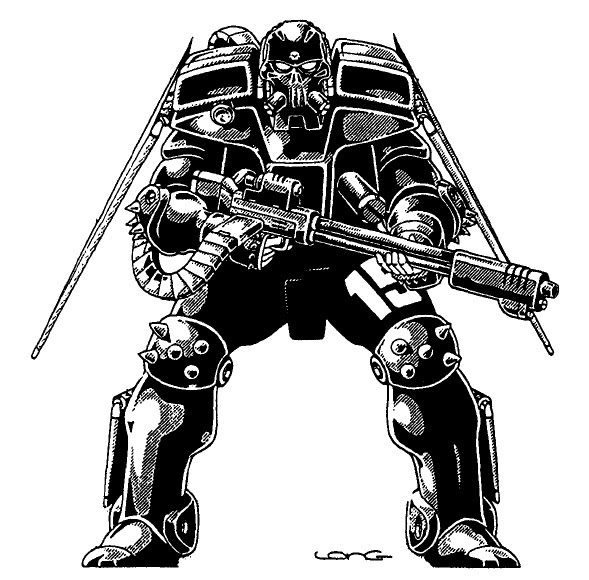
Along with the presence of magic, one of the big things that sets Rifts apart from the rest of the far-future, post-apocalyptic RPG pack is its inclusion of mecha. The game itself never uses the term "mecha", preferring the more unwieldy nomenclature of "robot vehicles" and "power armor". It seems that Palladium has reserved the word "mecha" for the Robotech RPG (and its related games, Robotech II: The Sentinels and Macross II, both long out of print), which is a shame, because it's a lot easier to write than having to say "robot vehicles and power armor" over and over again.

Anyway, where was I? Oh yeah: giant robots. Rifts has them. Lots of them, in fact. I'd say that at least half of the vast amount of books published for the game have a back cover blurb that proudly announces that yes, this one has new mecha in it. It's fairly unusual for game set in a post-apocalyptic world to emphasize mecha as strongly as Rifts does. Since Rifts is a setting where almost any enemy you encounter is able to deal incredible amounts of damage, armored vehicles (including the robot kind) are a basic necessity for most human characters, if they expect to survive.

Don't get me wrong: I love mecha, and I love that Rifts includes them even when it doesn't always make a ton of logical sense to have them stomping around all over the place. My problem is with the way the game handles them; more specifically, they generally have a ton of M.D.C. (Mega-Damage Capacity). They slow combat down tremendously, because the only way to take them down is to whittle away that M.D.C., which usually takes many, many attacks, most of which are actively and individually defended against.

In other words, Rifts mecha have too many "hit points". There are optional rules that cause malfunctions once 60% of a particular piece of the mecha's M.D.C. has been lost (did I mention that they have M.D.C. by location?), which is a nice thought, but also means that you have to crunch numbers during play to figure out, say, what 60% of this particular mecha's right arm M.D.C. is. It's fiddly, clunky, and overall quite unlike the fast-paced mechanized action that I think the game needs. The worst part is that I don't have any good ideas on how to fix it, because I don't want the mecha to blow up too easily. Just more easily.

Friday, March 14, 2014

Rifts Magic In Practice

Today, I want to talk about magic in Rifts. Don't worry, I'm not going to drone on about what magic is like in the Rifts setting, or complain about how it doesn't "feel magical" (a criticism aimed at any number of RPGs' handling of the concept). The Stabilizing Rifts blog has already done an excellent series of posts on the various types of magician characters in the game, as well as exploring the greater implications of magic upon the Rifts Earth milieu. (If you're somebody that wants to see the idea of magic in a post-apocalyptic science fiction setting taken seriously, I can't recommend these posts strongly enough.) Instead, I want to talk about the role magic is supposed to play in the game.

Magic is an integral part of the Rifts role-playing game, or at least, it's intended to be. It's essential to the game's backstory, in which what is initially a nuclear apocalypse accidentally triggers a magical, reality-rending devastation. Its presence in the setting is a large part of what sets Rifts apart from other science fiction or post-apocalyptic games. It's equally important to the North American setting the game originally presented, in which the (comparatively) technologically advanced Coalition States struggle to survive against malevolent practitioners of magic and supernatural beings. Or, if you prefer, it's a setting in which practitioners of magic and supernatural beings struggle to survive against the xenophobic and totalitarian Coalition. Or maybe it's the evil Coalition vs. the evil Federation of Magic...

The point is, the first major conflict laid out in the setting is fundamentally one of technology vs. magic, and it's not the only one -- Triax & the NGR would introduce a similar struggle (mecha vs. demons) in Europe. While the typical group of player characters is likely to include high-tech men of arms, practitioners of magic, psychics, and supernatural creatures, the backdrop is one of super-science vs. sorcery.

The funny thing is, magic isn't very powerful in Rifts. It's meant to be very powerful indeed, since it apparently poses a threat to a nation that fields thousands of skull-faced killer war machines on the battlefield. There are plenty of supernatural creatures that can put a hurting on an armored vehicle. But in play, it's hard to imagine even a group of magicians throwing down with mecha in a direct fight. Even after the introduction of nastier combat spells in Federation of Magic, the fact remains that high-tech weaponry does more damage, isn't limited by spell points (or P.P.E., in official Palladium parlance), and perhaps most importantly, can be used to attack many more times in a combat round than a magic spell can.

Kevin Siembieda has acknowledged this discrepancy several times. He argues that the true "power" of magic is in its unpredictable nature -- not that it's difficult for a practitioner to control, but the threat that somebody with the power to hurl energy bolts (without carrying a weapon) or to control people's minds would pose to a society obsessed with control like the Coalition. In terms of the setting, that's a strong case for magic as a scary thing. In practice, at the game table? Well, not so much. So you have to play smarter, says Siembieda. Magic spells in Rifts are often vaguely defined, so you have some leeway. Think outside the box, old school style!

Siembieda's argument for intelligent play makes sense, to a point. I have played a Mystic in Rifts for years, and quickly learned that a mage trying to go toe-to-toe with a mechanized foe in the firepower department isn't long for the world. The raw damage just isn't there, and in the rules as written, you're only going to be able to cast two Fire Ball spells per round, tops. Meanwhile, the man in the robot suit gets to fire at you four to six times, and if he hits you, you have to start over. (It's no mistake that one of the most popular house rules in Rifts, the "channeling" spellcasting system originally presented in an issue of The Rifter, dramatically speeds up magician characters' number of spells per round.) The key, for me as a player, was to pick spells that penalize, terrify, control, or otherwise "nerf" your enemies (and then either shoot them in the face with a laser rifle, or have your buddies do it) rather than to try to slug it out them.

The idea of magicians taking down these mechanized shock troops with low cunning and sneaky tactics has a certain "Empire vs. Ewoks" appeal, I suppose. However, at some fundamental level, it's kind of annoying that it's so hard to have a wizard striking down power armor-clad foes with fireballs and lightning in Rifts. I'm mostly okay with Rifts mages not being "the artillery" like they often are in D&D, but it still feels a little bit like a bait-and-switch.

Friday, March 7, 2014

In Defense of Mega-Damage

Rifts is a game with a lot of strange rules. Some are just old. Some are poorly explained. Some really don't make sense. One part of the rules that is probably mocked more than any other is the concept of Mega-Damage.

Mega-Damage first appeared (to my knowledge) in Palladium's licensed Robotech line of RPGs. The idea was that regular damage couldn't do justice to the scale of destruction that the giant mecha of the animated series were capable of dealing out. Enter Mega-Damage, one point of which was equal to one hundred points of regular damage (or "Structural Damage" in Kevin Siembieda's parlance), but with the caveat that attacks that dealt regular damage would never have any measurable effect on a Mega-Damage structure.

Siembieda's argument was that nothing that wasn't heavily armored could survive a direct hit from a tank cannon. Furthermore, you would never be able to inflict any serious damage to that heavily armored tank with something that wasn't specifically designed to do so. No matter how much of a badass you were, you could beat on that tank with a baseball bat all day, but you'd never do much more than scuff the paintjob. You could spray the tank with an Uzi and get similar results. But break out an anti-tank weapon, and you might be getting somewhere.

Mega-Damage, as I've mentioned before, is a much-lampooned concept, but I don't really understand why. (I think it must be the name, which is admittedly a bit goofy.) I think it makes a lot of sense. I certainly think that it makes a lot more sense than the extremely abstract concepts of "hits" (which aren't always hits), "damage" (which isn't always damage), or "healing" (which isn't always healing) in Dungeons & Dragons, a game which hundreds of thousands of people still play and enjoy without apparent confusion. At any rate, objections to Mega-Damage were apparently common enough that Siembieda provided guidelines on using removing Mega-Damage from the game in the Rifts Conversion Book, fairly early in the line's long life. We never used them.

Still, there are areas where the concept of Mega-Damage breaks down, or has what I think were probably unintended consequences. For one thing, the widespread availability of Mega-Damage weaponry in Rifts means that characters tend to walk around in full environmental body armor at all times. Even tools like laser torches used for welding can inflict Mega-Damage, which means that a street thug with a dinky laser pistol has the ability to level a city block or wipe out your lovingly crafted character with a single hit. For another, by the rules as written, even a glancing hit from a Mega-Damage weapon will almost certainly kill your character instantly -- you're either armored and okay, or you're dead and turned to a fine mist. A good GM can work around these issues, but they remain nevertheless. (There was an attempt to address the "either you're okay or you're bloody mist" problem in Rifts Ultimate Edition, but its so-called "GI Joe Rule", where you always survive the hit that depletes your armor, but are now unprotected and presumably running for your life, actually is the cartoonish joke Mega-Damage has been made out to be, and has just made matters worse.)

For the upcoming Rifts campaign in which I'm participating, my GM is experimenting with reviving an older Palladium system, Armor Rating, which by the book works similar to D&D's Armor Class: if you roll over the Armor Rating, you've bypassed the armor and damaged the person inside. That seems potentially promising, but I'm not sure how it will work for something like a fully enclosed vehicle (like the vast majority of the mecha in Rifts) or for living creatures that are Mega-Damage structures, which are plentiful in the game. I know that he's using AR in a different way, however, and I'm interested to see what he does with it.