For our fourth session, the Company of the Closed Fist was back up to fighting strength:
Aelaran the Resilient (male cleric), played by Bret
Cadie Stone-Spar (female dwarf), played by Jaime
Garen-Gen (male halfling), played by Dan
Magda the Witch (female magic-user), played by Chris H.
Ondola the Blunt (female fighter), played by Chris V.
plus their retainers: "Big John" the charmed ogre, Bardoon, Worford, Ralan the elf and Mordal the dwarf
Having neutralized the threat of the orcs and other Nisshar deserters that had occupied the ruins of the Falcon Hall, the Company of the Closed Fist received a summons from Arjon Tenpher, the man who rules the Duchy of D'Ansor in his brother's absence. Tenpher informed the Company that far from being cross about the deaths of two of his personal guard (and one prize sheep) in the Falcon Hall assault, he considered it a bargain, and requested that the Company investigate reports of new inhabitants at Ralu's Redoubt, a roadside outpost that was previously believed to be abandoned after the recent war with Nisshar. Tenpher suspected that a group of bandits that had been raiding caravans traveling between the Duchy and their southern neighbors in the Principality of Timur may have claimed the outpost as their own.
The Company first contacted two survivors from the first Falcon Hall operation: the jittery, knife-wielding Otto, and the arrogant (if capable) Bardoon. Only the latter accepted their offer of re-employment. Aelaran chose to employ a town crier for a nominal fee, which reaped considerable rewards: several capable-seeming retainers, including a dwarf and one of the rarely-seen elves, offered their services. A new pay scheme was determined for the Company's retainers: a fairly generous flat monthly fee, plus salvaged weapons and armor, with opportunities for formal registry into the Company's roster (and thus, access to the various advantages of a royally chartered mercenary group) for particularly loyal and doughty retainers. (I love watching players come up with this kind of stuff, by the way.)
The Company then spent a good deal of time planning a ruse intended to lure the bandits out into the open, involving a wagon and a pair of draft horses borrowed from Tenpher, and a cart purchased with Company funds. Elaborate plans involving the lashing of demihumans to the undersides of these conveyances, the donning of false pilgrims' costume, and the inconspicuous transport of charmed ogres were hatched. Finally, the Company and their companions set out on the two-day journey southward to Ralu's Redoubt.
Despite conspicuously camping in view of the outpost, the ambush they expected never came. After a nervous evening spent waiting for a bandit attack, Garen-Gen decided to reconnoiter the Redoubt along with the elf Ralan. They found a large, conical hill with two cavernous openings apparently manned by watchmen and dotted with withered trees. Magda the Witch and her ogrish friend, "Big John", decided to approach the outpost with Garen-Gen and Ralan observing from cover. As soon as they came within roughly two hundred feet of the outpost, the "watchmen", who were now seen to be skeletons, signaled a green-robed figure who cast a sleep spell upon the witch and her would-be protector. Both were instantly sent into a slumber. Before the skeletal guards could approach, Garen-Gen and Ralan burst from the bushes and awakened their ensorcelled comrades. The four then fled for cover, with "Big John" howling in rage and confusion, as three skeleton warriors and two very nervous-looking green-robed magic-users emerged from the complex, and then quickly returned to it.
Hearing the ogre's screams, the rest of the Company came to the rescue, and the assembled party then entered Ralu's Redoubt at its upper opening. They soon found a Timurian merchant (named Nomahr) in chains, who told them the bandits that captured him had apparently been overrun by wizards some days previous. The group decided to have Worford take Nomahr and their cart and wagon back to D'Ansor and inform Arjon Tenpher of the developments. They found little else of interest on this level -- save, of course, a magical mirror that robbed Magda of much of her already meager strength when she gazed into it. The session ended as the Company took a downward-leading staircase, "Big John" in the lead, with the evil mirror strapped to his ample torso.
I let the players spend a lot of time planning their counter-ambush this session -- in retrospect, probably too much time, but I didn't want to give away that the bandits they were expecting were no longer the threat. I'm also finding it difficult to get the sort of engaged roleplaying I enjoy going on Google+, which is much more my own fault (and that of the somewhat awkward nature of Hangouts) than that of my players, but I'm planning on forging ahead. I wonder if my players have yet figured out that this whole campaign is really just a way for me to learn how to DM again.
Friday, September 13, 2013
Friday, September 6, 2013
Hug a Jug o' Wine
If you're here for Dungeons & Dragons content, you'll probably want to move on. Today I'm writing about Rifts. A lot.
I have spoken in the past of the Rifts campaign I and my friends played in for years as young adults. Rifts is a game with a lot of warts, but its setting remains one for which I have a lot of affection. We've returned to it once before, in a play-by-post campaign that fizzled out (as they all do eventually). Recently, my good friend Kent has started a private Google+ Community for the old gaming group, and is slowly building a new campaign backdrop: Serendipity, an independent town with a commanding position at the mouth of the Mississippi River, since New Orleans was completely submerged after the apocalypse. Kent asked us to pitch some ideas for neighborhoods in Serendipity, and I obliged.
So, with a tip of the hat to the Borderlands video games and to Neil Hamburger's track of similar name, I give you:
Jugtown
The ramshackle bungalows at the northern edge of Serendipity are home to scrapyard workers, petty operators, and rail laborers. These people unload and process the scrap and excavated technologies taken from the McComb Metal Reclamation Camp, several miles further north. They work hard and drink hard. Sandrine Quang is happy to cater to their needs, and from her sprawling establishment, the Scrap Car Saloon, she effectively rules the neighborhood that has come to be called Jugtown.
The Quang family claims Cajun, Creole, and Vietnamese heritage. They have roots in the area going back to the time before the war, where they helped to operate the Ponchartrain Vineyards once located in the town of Bush (now a half-submerged ruin). The Quangs are still winemakers, growing grapes not far from the Ottley farming operation, but now produce a cheap, easily manufactured variant of the spirit labeled "Rasteau Pardo Tonic Wine". Detractors say that the Quang wine is adulterated with corn syrup, turpentine, and less savory additives. Sandrine Quang insists that it is “fortified”. At any rate, Pardo has been popular with the local workers for generations, and the trademark one-handled glass jugs in which the beverage is sold litter the streets and corners of the neighborhood. It is from these discarded containers that Jugtown takes its name.
The Quang family has its hands in more than making cheap wine. Sandrine's husband, Sullivan, works to ensure that the best pieces recovered from McComb find their way onto the black market. Her sister, Corette Quang, oversees prostitution and drug dealing in Jugtown. And Sandrine’s son, Orson, is directly involved in enforcing the family’s protection racket. (A full-conversion cyborg with the words “BOW DOWN” emblazoned on his chest, Orson Quang is among Serendipity’s least popular residents.) Quang family members are involved in practically all areas of business – and crime – in Jugtown.
Since the residents of the area depend either directly or indirectly on railyard activity for their livelihood, Jugtown's political affairs are largely handled by Serendipity's Rail Guild. However, the Quangs have assembled the Brotherhood of Maintenance of Way Employees, a militia named after a trade union from the Age of Man, and are aggressively recruiting area toughs to join it.
According to Sandrine Quang, the BMWE (or “Brotherhood”, as it is more commonly known) was formed to voice the unique concerns of Jugtown's workers. More often, they try to strongarm the Rail Guild into paying Sandrine in return for the militia's (and therefore, the workers’) support on the council. The militia is made up of two dozen or so local hardcases loyal to the Quang family, mostly low-level men-at-arms with cheap body armor and weapons. However, the Brotherhood supplies a valuable defense asset to Serendipity in the form of a fully operational Titan Combat Robot, purchased by the Quang family and piloted by the militia's leader, Rachel Bailey.
Bailey, a former combat pilot, had a history of squabbles with the Rail Guild before joining the Brotherhood. When still a newcomer to Serendipity, she married into the Quang family without fully understanding what she was getting into. A conscientious deserter from Whykin who disliked her homeland's increasingly xenophobic military policies, Bailey found herself pressured back into the pilot's seat and into acting as a figurehead for the BMWE. She has an honest desire to better represent Jugtown’s citizenry, but has found herself alternately manipulated and intimidated into serving Sandrine’s interests by her husband (and Sandrine’s nephew), Denis. As a result, her standing in the community is steadily plummeting.
The Scrap Car Saloon
Sandrine Quang's saloon is, like most of the buildings in Jugtown, a jury-rigged, ramshackle structure, apparently bolted together from the bits of a half-dozen other buildings. Unlike most of the quietly depressing drinking holes in this neighborhood of Serendipity, however, the Scrap Car goes for bombast. Bright orange power cords are strung haphazardly both inside and out. A loudly buzzing neon sign advertises “SCRAP CAR - WINE - GIRLS - WILDE - NTERTAINMENT [sic]” in hot pink letters, and loudspeakers pointed in all directions blast skip-ridden recordings of Vietnamese pop, Cajun zydeco, and Gobblely drum n’ screech (often all at the same time).
Past an entrance guarded by large, largely disinterested doormen lies a poorly lit, smoky, but slightly less shabby interior. Beyond what one would expect to find in a saloon – i.e., a bar -- the Scrap Car boasts a small stage for live performances (complete with scavenged sound and lighting system, and which can be surrounded with chicken wire at a moment’s notice) as well as an octagonal pit used to host tough-man tournaments, cockfights, dog fights, and the like. (An ill-fated experiment in carnosaur baiting once nearly led to the destruction of the saloon.)
The entire operation is monitored via video camera by Sandrine Quang, who occupies the well-guarded second floor of the establishment with a rotating cast of other Quang family members. While there are nude dancers (Thursday is “D-Bee night”), and plenty of alcohol is available, hard drugs and sexual favors are not offered here. (Customers interested in such services are quietly directed to other venues, also Quang owned and operated.)
Quanglish
A pidgin language composed of bits of half-remembered Vietnamese and Cajun French, mixed with American (and more recently, Gobblely), used exclusively by the Quangs. "Quanglish", as outsiders derisively call it, has allowed effectively coded communication among family members for generations. Individuals not raised in the Quang family -- even those that speak the languages that make up its vocabulary -- find Quanglish incomprehensible, as it also incorporates cross-lingual rhyming slang.
Thursday, August 29, 2013
The Demon Verge: Session 3
We were short one player last session, but the newly christened Company of the Closed Fist returned to the Falcon Hall to clear it once and for all:
Aelaran the Resilient (male cleric), played by Bret
Cadie Stone-Spar (female dwarf), played by Jaime
Magda the Witch (female magic-user), played by Chris H.
Ondola the Blunt (female fighter), played by Chris V.
plus their retainers: Wart, Mordu, Janus, and Yar
Two of the Company's retainers from the previous expedition, Otto and Bardoon, declined to return to the ruined outpost for this sortie. The players talked the local lord, one Arjon Tenpher, into loaning them two of his personal guard (Janus and Yar) and, at the insistence of the halfling Garen-Gen, five sheep at the end of the previous session. Sadly, Garen-Gen proved to be highly allergic to the local breed of sheep and had to remain back at camp while his comrades stormed the Falcon Hall.
The player characters again used some very imaginative tactics, including herding their sheep into the dungeon in an attempt to set off any booby traps. Unfortunately, the denizens of the Hall had enlisted the help of a small squad of kobold trapsters, who had made a barricade of the orcs and goblins the Company had slain last session and seeded them with shrieker spores. The crawling fungi immediately alerted the tribe to the Company's presence, sending the sheep bolting back outside. The kobolds then hurled crocks of oil at the party's magic-user, Magda the Witch, and ignited them. She would have been killed were it not for the speedy intervention of Mordu, the guardsman she had charmed into her service last session.
The Company set about setting the kobolds' grisly barricade alight and then sealing the orcs and their allies inside the dungeon, barring the main doors and sealing its chimney with a promptly slaughtered sheep. A previously unknown escape tunnel was soon revealed, and the party tracked the Hall's fleeing inhabitants to a muddy creek, where a pitched battle took place.
The skirmish claimed the lives of every one of the Company's retainers. The orcs' trump card, a club-wielding ogre, was charmed by the badly burnt Magda and then instructed to give the party a tour of the Falcon Hall. The Company of the Closed Fist returned to D'Ansor considerably richer, but it remains to be seen how Arjon Tenpher will react to the loss of two of his trusted men at arms.
The big lessons that I took home from this session? Smart play yields great rewards, players react with dread when you use their tactics against them, and charm is a great spell.
Friday, August 23, 2013
The Demon Verge: Session 2
The first session of the Demon Verge campaign must not have been too awful, because everybody returned for the second, to wit:
Aelaran the Resilient (male cleric), played by Bret
Cadie Stone-Spar (female dwarf), played by Jaime
Garen-Gen (male halfling), played by Dan
Magda the Witch (female magic-user), played by Chris H.
Ondola the Blunt (female fighter), played by Chris V.
plus their retainers: Wart, Otto, and Bardoon
Last session, the player characters took a staircase to the second level of an abandoned outpost and started spiking the sliding door that led out of its first room. This alerted goons on both the second and the first floors (the latter of which they had not cleared) to their presence. Though they got out mostly intact (more on that in a bit), it was a lot of fun watching the players figure out how to deal with the orcs and goblins that started arriving in waves from both the stairwell and the doorway, potentially leaving them with no exit.
I'm happy to say that using a relatively small dungeon that I mapped and keyed myself has contributed greatly to my own confidence in running a D&D session. It helped me have a better idea of how things interconnect and interrelate. Knowing your dungeon well enough to have its various denizens react appropriately when adventurers start stomping around and killing their buddies is not only realistic, it makes the dungeon scarier. It allowed me to avoid the unfortunate syndrome where monsters sit and patiently wait to be killed, ignoring the ruckus that the PCs are raising.
Also, one of the orcs scored a natural 20 on my brother's fighter, Ondola the Blunt, and reduced her well below 0 hit points, which let me try out my house rules on both critical hits and mortally wounded characters. (I use the term "house rules" loosely here -- I have lifted these rules wholesale from Adventurer Conqueror King.) After a couple of die rolls it ended up that Ondola was unconscious and had lost an arm. This did deflate the session for a bit, and my brother elected to drop out of the game for the night. I felt kind of bad about this, to be honest -- I wondered if it wouldn't have been better for me to simply declare the character dead -- but it looks like my brother is going to soldier on with his one-armed fighter for at least a little while.
The PCs managed to escape the dungeon, though they were pursued and had to bluff their way out. Also, an orc that Aelaran the cleric had managed to talk into aiding the party was slain by an overzealous guardsman when they returned to town. (That guardsman has since been charmed into their service.) Sadly, most of their retainers elected to retire with the treasure they'd won. I did squeeze in some (rather awkward) roleplaying with the local nobility, which I think was nice for a change.
Next week, the players are planning on clearing out the rest of the Falcon Hall, and have procured large amounts of oil, new men-at-arms, and five sheep to that end. This can only end well.
Friday, August 16, 2013
What Is A Demon? (Part I)
Though my campaign is called "The Demon Verge", I don't really have a clear idea of what the titular "Demons" are. This is largely because the game it's based on doesn't provide much information about them. That sketchiness has mostly been a boon for me thus far. Still, I feel kind of strange about leaving the villains of the setting in such a vague state, so I might as well start figuring some things out.
As I've discussed previously, the wargame Demonlord includes a dwarven kingdom that is menaced by something called "the Balron". It's one of the few things in the game that is a transparent Tolkienism. For the Demon Verge campaign, I try not to directly contradict anything from the game that inspired it, but I have to admit that I kind of roll my eyes every time I have to mention the Balron. For that reason, I decided that the Balron is understood to have been slain by a powerful wizard during the last war. (I figured if I'm going to have a Tolkien ripoff stomping around in the backstory, I might as well write it out with another Tolkien ripoff.)
For laughs, I decided to do an image search for "Balron" (as opposed to "Balrog", which gets you a lot of images of the monster from Jackson's Lord of the Rings films and the big boxer from Street Fighter II). Here's what I get:
Both are apparently from manuals for the Ultima series of computer games, which also used the name "Balron" instead of "Balrog". They've both got the sword-and-whip thing going on, just like the Balrog. Like the designers of Demonlord, the Ultima people obviously liked Tokien's Balrog enough to use it in their game, but probably feared legal trouble from those controlling his intellectual property. Fair enough, but I find this kind of direct ripoff a bit uninspiring, even though I have a soft spot for Denis Loubet's artwork.
I stumbled across another "Balron" during my search, though:
This Balron is a villain from the Saint Seiya anime series, as far as I can tell. The sword has been jettisoned from the standard Balrog armament, and instead of a big leathery beast, this version is a pretty man in demonic armor. I actually find this take kind of interesting, because to me it seems to be somewhat in line with what little is written about the Demons in the Demonlord rules manual:
On Narth, once called the “continent of man”, the origins of the Demons are obscure. Some say a wizard’s summoning went out of control. Others suggest that the Demons themselves opened a magical gateway, still extent [sic] at the gate of Tor’zem, the Demonlord Capital. A few philosophers even believe that the Demons are a natural race, like humans or dwarves, except the Demons became stronger than others.
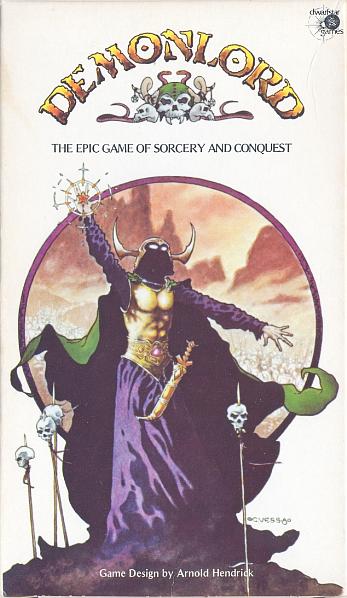
In that rulebook, it's never stated that "the Balron character" is a Demon. But the mention of the Demons possibly being "a natural race, like humans or dwarves," suggests to me that they are probably not completely monstrous in appearance. The Demonlords themselves are depicted on their chit counters as horned heads with Dracula-style collars, and one could reasonably assume that the individual on the cover of the game is meant to be a Demonlord. (The Balron's chit looks a little different from that of the various Demonlords: its silhouette is vaguely humanoid, with horns, wings, and big feet.) Whether or not the Balron was a Demon, the idea of mostly human-like Demons like "Balron Rene" is an appealing possibility for my campaign.
As I've discussed previously, the wargame Demonlord includes a dwarven kingdom that is menaced by something called "the Balron". It's one of the few things in the game that is a transparent Tolkienism. For the Demon Verge campaign, I try not to directly contradict anything from the game that inspired it, but I have to admit that I kind of roll my eyes every time I have to mention the Balron. For that reason, I decided that the Balron is understood to have been slain by a powerful wizard during the last war. (I figured if I'm going to have a Tolkien ripoff stomping around in the backstory, I might as well write it out with another Tolkien ripoff.)
For laughs, I decided to do an image search for "Balron" (as opposed to "Balrog", which gets you a lot of images of the monster from Jackson's Lord of the Rings films and the big boxer from Street Fighter II). Here's what I get:
Both are apparently from manuals for the Ultima series of computer games, which also used the name "Balron" instead of "Balrog". They've both got the sword-and-whip thing going on, just like the Balrog. Like the designers of Demonlord, the Ultima people obviously liked Tokien's Balrog enough to use it in their game, but probably feared legal trouble from those controlling his intellectual property. Fair enough, but I find this kind of direct ripoff a bit uninspiring, even though I have a soft spot for Denis Loubet's artwork.
I stumbled across another "Balron" during my search, though:
On Narth, once called the “continent of man”, the origins of the Demons are obscure. Some say a wizard’s summoning went out of control. Others suggest that the Demons themselves opened a magical gateway, still extent [sic] at the gate of Tor’zem, the Demonlord Capital. A few philosophers even believe that the Demons are a natural race, like humans or dwarves, except the Demons became stronger than others.
In that rulebook, it's never stated that "the Balron character" is a Demon. But the mention of the Demons possibly being "a natural race, like humans or dwarves," suggests to me that they are probably not completely monstrous in appearance. The Demonlords themselves are depicted on their chit counters as horned heads with Dracula-style collars, and one could reasonably assume that the individual on the cover of the game is meant to be a Demonlord. (The Balron's chit looks a little different from that of the various Demonlords: its silhouette is vaguely humanoid, with horns, wings, and big feet.) Whether or not the Balron was a Demon, the idea of mostly human-like Demons like "Balron Rene" is an appealing possibility for my campaign.
Friday, August 9, 2013
The Demon Verge: Session 1
After I straightened out some scheduling conflicts, I was able to run the first session of the Demon Verge campaign this past Monday on Google+.
Our heroes were:
Aelaran the Resilient (male cleric), played by Bret
Cadie Stone-Spar (female dwarf), played by Jaime
Garen-Gen (male halfling), played by Dan
Magda the Witch (female magic-user), played by Chris
Ondola the Blunt (female fighter), played by my brother (also named Chris)
plus their retainers, Wart, Otto, and Bardoon
The characters are part of a larger force sent to the Demon Verge to pacify the war-torn and chaos-stricken borderlands. They started out in the Duchy of D'Ansor, collected a few rumors, and decided to investigate reports of orcs, ogres and the like -- presumably deserters from the war between the Demon province of Nisshar and the Hosarite alliance -- preying upon the farming villages to the northwest of town. They were able to track them to an ancient dwarven ruin set into a hillside, and with some clever reconnaissance and liberal use of flaming oil, managed to lure out and slay several of its inhabitants (orcs, goblins, and giant toads) before entering its partially waterlogged interior.
So, as you can see, it was a pretty basic setup (evil humanoids in a dungeon) but I had a lot of fun running it. I really enjoy playing hirelings, goblins, and other "bottom of the barrel"-type characters, and the Meatshields! hireling & henchman generator does an excellent job of instantly creating memorable goons. I also learned some lessons about flaming oil that I had forgotten (namely, that it is incredibly powerful). The players made some very smart choices in tackling the ruins and their inhabitants, got a ton of lucky rolls (no wandering monsters!) and as a result, have managed to acquire quite a nice heap of treasure with no loss of life or limb... yet.
This session was a big improvement over my previous attempts to run a game on Google+, at least in terms of my own confidence and enjoyment. That's due in no small part to the fact that this time, I'm running a relatively small dungeon that I stocked myself, rather than a giant megadungeon that requires hours of study and preparation. So far I haven't gotten the feeling that I'm "screwing up" -- justified or not -- that I often get when running others' material.
I got very valuable feedback from my players, including that they want more opportunities for roleplaying, which was a lovely thing to hear. So, a success, I think.
Thursday, August 1, 2013
Domains of the Demon Verge
Here's a (sort of) brief summary of what I've established about the Demon Verge setting, some of it extrapolated from Demonlord, and some of it made up whole cloth. This represents knowledge that player characters, who are not native to the region, would already know (or be able to glean with little effort).
The Kingdom of Altacia
Often referred to simply as "the Old Kingdom", Altacia is the largest human nation on the continent of Narth. It was once the preeminent power in the region, but is now in decline, challenged by its neighbors, the realm of Ekkesh (to the south) and the Demon Provinces (to the east).
The Duchy of D'Ansor
A realm whose people have as much in common with the cragsmen of Altu'han as they do with the Altacian people, D'Ansor only recently bent the knee to the Old Kingdom. Its capital is home to the only magical college in the region. The villages of the Duchy are terrorized by brigands, deserters from both sides of the recent war.
The Principality of Timur
The largest city in the region, save Nisshar, Timur is the eastern trade hub of the Old Kingdom, now wracked by banditry. Once the stronghold of the Hosar faith, it was here that the High Priest was slain in battle, and Hosar's influence here is now as diminished as the spirits of those who were once its adherents.
The Barony of Barthek
A swampy land regarded as a cultural backwater in the Old Kingdom. Since the death of its Baron, Barthek is torn by internal strife between the Altacian nobles that have inherited it, and its people, whose traditions are closer to those of Ekkesh, a southern nation with a long history of conflict with the Old Kingdom.
The Kingdom of Ula
Until one year ago, the Dwarves of Ula toiled under the eye of the abomination known as the Balron and the Trolls that served it. Freed when the wizard Rabat slew the Balron, the Dwarves aided the alliance of Hosar in driving back the forces of Nisshar. Though freedom has come to the Dwarves, untold numbers of slaves yet toil in their mines, and it is said that slavers in Ula's employ still bring travelers to their mountains in chains.
The Duchy of Altu'han
The "mountain realm of the cragsmen", Altu'han is a northern domain ruled from a fortress city. Much of what is now the Duchy of D'Ansor was once the cragsmen's territory. Altu'han was briefly conquered by the Altacians, but its people have proven untamable, and for over a century the Duchy has been a part of the Old Kingdom in name only.
The Principality of Lyung
"Realm of the Sorcerer Cloud Prince", Lyung is an enigma even to its neighbors. What is known is that its capital is impregnable, and that none have been granted an audience with the Cloud Prince in generations. Legends say that the warriors of Lyung ride great dragons into battle, and indeed, some assert that they have seen the figures of men on winged creatures crossing the central plains.
The Great Woods
Home of wild warrior tribes, known worshippers of beast gods and forest spirits. Reputed to be not entirely human, the Great Woods barbarians are unpredictable, allying with Demons or men (or neither) according to their whims, and since the last war, the barbarians' raids against the eastern villages of Timur and Barthek have only grown bolder.
The Land of the Ancients
A nearly forgotten race, the Ancients ruled the hills and plains of the entire region in ages past, and their prehistoric ruins dot the landscape. It is said that the last remnants of the Ancients dwell in a crumbling temple to the north of Nisshar, and that the Demons give a wide berth to this land.
The Province of Nisshar
Westernmost province of the Demon Emperor's domain, Nisshar consists of several sprawling city-states and fortresses in a largely barren expanse of steppe, desert, and badlands. Each of these city-states is ruled by a Demonlord that swears fealty to the Imperial capital, Tor'zem, far to the east. The cities of Nisshar, Erush, and Taegul are places of despair, where men, demi-men, goblins, orcs and all manner of other beings live in common fear of the lash of their accursed masters.
The Kingdom of Altacia
Often referred to simply as "the Old Kingdom", Altacia is the largest human nation on the continent of Narth. It was once the preeminent power in the region, but is now in decline, challenged by its neighbors, the realm of Ekkesh (to the south) and the Demon Provinces (to the east).
The Duchy of D'Ansor
A realm whose people have as much in common with the cragsmen of Altu'han as they do with the Altacian people, D'Ansor only recently bent the knee to the Old Kingdom. Its capital is home to the only magical college in the region. The villages of the Duchy are terrorized by brigands, deserters from both sides of the recent war.
The Principality of Timur
The largest city in the region, save Nisshar, Timur is the eastern trade hub of the Old Kingdom, now wracked by banditry. Once the stronghold of the Hosar faith, it was here that the High Priest was slain in battle, and Hosar's influence here is now as diminished as the spirits of those who were once its adherents.
The Barony of Barthek
A swampy land regarded as a cultural backwater in the Old Kingdom. Since the death of its Baron, Barthek is torn by internal strife between the Altacian nobles that have inherited it, and its people, whose traditions are closer to those of Ekkesh, a southern nation with a long history of conflict with the Old Kingdom.
The Kingdom of Ula
Until one year ago, the Dwarves of Ula toiled under the eye of the abomination known as the Balron and the Trolls that served it. Freed when the wizard Rabat slew the Balron, the Dwarves aided the alliance of Hosar in driving back the forces of Nisshar. Though freedom has come to the Dwarves, untold numbers of slaves yet toil in their mines, and it is said that slavers in Ula's employ still bring travelers to their mountains in chains.
The Duchy of Altu'han
The "mountain realm of the cragsmen", Altu'han is a northern domain ruled from a fortress city. Much of what is now the Duchy of D'Ansor was once the cragsmen's territory. Altu'han was briefly conquered by the Altacians, but its people have proven untamable, and for over a century the Duchy has been a part of the Old Kingdom in name only.
The Principality of Lyung
"Realm of the Sorcerer Cloud Prince", Lyung is an enigma even to its neighbors. What is known is that its capital is impregnable, and that none have been granted an audience with the Cloud Prince in generations. Legends say that the warriors of Lyung ride great dragons into battle, and indeed, some assert that they have seen the figures of men on winged creatures crossing the central plains.
The Great Woods
Home of wild warrior tribes, known worshippers of beast gods and forest spirits. Reputed to be not entirely human, the Great Woods barbarians are unpredictable, allying with Demons or men (or neither) according to their whims, and since the last war, the barbarians' raids against the eastern villages of Timur and Barthek have only grown bolder.
The Land of the Ancients
A nearly forgotten race, the Ancients ruled the hills and plains of the entire region in ages past, and their prehistoric ruins dot the landscape. It is said that the last remnants of the Ancients dwell in a crumbling temple to the north of Nisshar, and that the Demons give a wide berth to this land.
The Province of Nisshar
Westernmost province of the Demon Emperor's domain, Nisshar consists of several sprawling city-states and fortresses in a largely barren expanse of steppe, desert, and badlands. Each of these city-states is ruled by a Demonlord that swears fealty to the Imperial capital, Tor'zem, far to the east. The cities of Nisshar, Erush, and Taegul are places of despair, where men, demi-men, goblins, orcs and all manner of other beings live in common fear of the lash of their accursed masters.
Subscribe to:
Posts (Atom)


.jpg)